Amplimesh vs Crimsafe Security Doors
Amplimesh and Crimsafe are the two heavyweights of the security door world, but they go about security differently. You’re essentially choosing between a screw-clamp system and a pressure-fit wedge, not to mention the jump from 304-grade steel to 316 marine-grade.
We’ve cut through the brochures to give you the real-world facts on how they compare. We’re looking at everything from how they handle the salt air to whether they’ll mess with your view. No sales pitch; just the tech and the trade-offs you actually need to know.
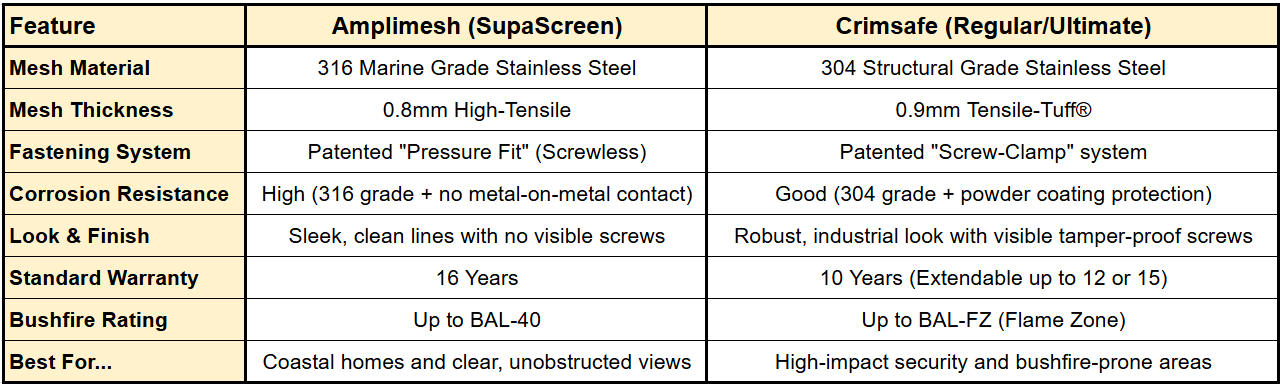
At a Glance: Amplimesh vs Crimsafe Comparison Table
This table cuts through the fluff and gives you the facts. It’s exactly what you need to look at when comparing the two, especially if you're dealing with the salt air here in Moreton Bay.
Understanding the Fastening Systems: Screw-Clamp vs Pressure Fit
This is where the two brands really part ways. The way the mesh is fixed into the frame is a big deal; it’s the difference between a door that rattles in a storm or corrodes in the salt air and one that stays solid for years.
Crimsafe: The Screw-Clamp™
Crimsafe is all about that physical clamp. They don’t bother with wedges or glue; they sandwich the mesh between serrated plates and screw it straight through the lot.
On the newer Classic and Ultimate models, they’ve even upgraded to a carbon fibre clamp and hidden the screws under a cover. It’s a vice-like grip; even if someone goes at it with a crowbar, that mesh isn't budging.
The Look: It’s a sleek, screw-free look. They use a clip-on cover to hide all the fixings, so you don't get that ‘industrial’ look of visible screw heads.
The Benefit: It uses a carbon fibre-reinforced clamp that basically "bites" the mesh. It’s a vice-like grip that’s rated for huge impacts, up to 750 Joules, so it’s not going anywhere if someone tries to kick it in.
Amplimesh: The Pressure-Fit Wedge
Amplimesh is a screwless setup. The mesh is wedged into the frame under high pressure, leaving a clean finish without any visible screws or clip-on covers.
The Look: It’s basically a ‘frameless’ look. Without screws or clip-on covers, it just looks like a clean, modern piece of joinery.
The Benefit: It uses a pressure-fit wedge and a PVC insulator. This keeps the mesh and frame from actually touching, which is a massive win for stopping salt-air corrosion.
Both pass the Australian Standards easily. If you want the strongest grip on the market and don't mind a slightly chunkier frame, Crimsafe is the one. But if you’re after a cleaner, screwless look and you want something that basically takes care of itself in the salt air, Amplimesh is the way to go.
Corrosion Resistance: 304 Grade vs. 316 Grade Stainless Steel
Not all stainless steel is the same. If you’re living in Moreton Bay, the salt air is your door's biggest enemy, and this is where the choice between Amplimesh and Crimsafe gets interesting.
Amplimesh (High Tensile 316 Marine Grade)
It’s a bit thinner at 0.8mm, but it’s got molybdenum mixed in. That’s the secret sauce that stops 'tea staining', those ugly brown rust spots you see on cheap steel near the ocean.
Don’t let the 0.8mm fool you. Because it’s 316 grade, it's actually higher tensile than the thicker stuff, so you’re not giving up any security just to get that rust protection.
Crimsafe (304 Structural Grade)
Crimsafe goes with a thicker 0.9mm mesh, which is why it's so tough for pure impact. But since it’s 304-grade, it does need a bit more love. You’ve got to stay on top of the cleaning to stop salt from sitting in the weave and causing rust spots, especially if you’re close to the bay.
Visibility & Airflow
Essentially, you're looking at two very high-end flyscreens. The big difference is how that wire thickness messes with your view once they're actually installed.
Amplimesh Visibility & Airflow
Since the wire is a bit thinner at 0.8mm, the weave isn't as ‘closed in’. It basically disappears once it's up, and you’ll definitely notice the extra breeze, which is a lifesaver on those sticky, still afternoons when there’s barely a puff of wind.
Crimsafe Visibility & Airflow
The 0.9mm wire is a bit chunkier, so it doesn't quite ‘vanish’ like the thinner mesh. It looks and feels a lot more substantial from the footpath, which is actually a win if you want a visible deterrent that tells people not to even bother trying your door.
Australian Standards & Impact Testing
In Australia, a screen isn't legally 'security' unless it survives five 100-joule hits. Most brands just aim for that pass mark, but Amplimesh and Crimsafe basically treat it as a warm-up.
Amplimesh Impact Testing
They use a pressure-fit system that wedges the mesh into the frame. It’s been tested to withstand over 3,200 Joules. Because there are no screws, a kick’s energy spreads across the whole door rather than putting all that stress on a few small screws that could snap.
Crimsafe Impact Testing
They use a screw-clamp system that basically bites the mesh with a vice-like grip. The Classic range handles 550 Joules, but if you step up to the Ultimate, you’re looking at 750 Joules. The clever bit is that the harder someone kicks it, the tighter that carbon fibre clamp actually grips the mesh
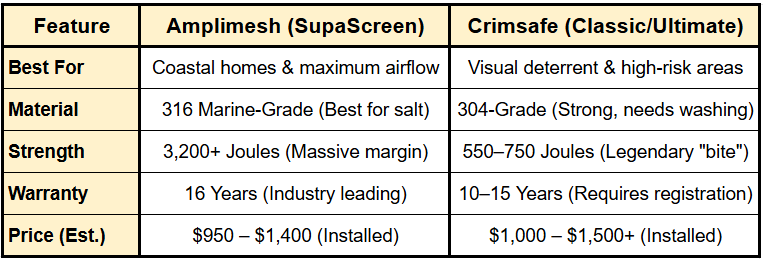
The bottom line? If you want that iconic "don't even try it" look and the famous clamp grip, you go with Crimsafe. But if you’re chasing a cleaner look and want a door that technically survives way more punishment, plus a slightly longer 16-year warranty, Amplimesh is the one.
The Verdict: How to Choose
Go with Amplimesh if:
- You're on the water
- You want the best view
- Maximum airflow is key
- Long-term value is priority
Go with Crimsafe if:
- A visual deterrent is vital
- You want "bite" technology
- You're in a bushfire zone
- Brand name matters
Ready to get a price? Give us a shout on 0439 015 936 or complete our enquiry form, and we’ll get you sorted with a measure and quote.
Frequently Asked Questions
Can I get a pet door in an Amplimesh screen?
You can, but honestly, it’s a trade-off. Once you cut a hole for a flap, it legally can't be called a 'security' door under Australian Standards; it’s downgraded to a 'safety' door. It’s still tough as nails, but that pet flap is basically just a hole a clever intruder could use to reach your locks.
Will Crimsafe make my house look like a prison?
Honestly, it’s the opposite. People worry about that caged-in feel, but from the street, it just looks like a dark, premium flyscreen. The cool thing is that the black mesh acts like sunglasses for your room; it cuts the afternoon glare and actually makes it easier to see your backyard than the old silver mesh ever did.
Is 316 stainless steel really worth the extra money in Moreton Bay?
If you’re within 5km of the water, it’s a no-brainer. Crimsafe’s 304-grade is incredibly strong, but it’s a magnet for salt. If you don't stay on top of the cleaning, you'll start seeing those brown 'tea stains' within a year. Amplimesh uses 316 Marine-Grade, which is built for the spray; it's way more forgiving if you'd rather spend your Saturdays at the beach than scrubbing a door.
Resources:
My Security Door - Crimsafe vs Amplimesh
Clearview Security - Which Is Better: Crimsafe or Amplimesh?
Have a Go News - Amplimesh® vs Crimsafe: Which Security Screen Offers Better Protection?
Bayside Security Doors - Is there an alternative to Crimsafe? Meet Amplimesh
Choice - What to know before buying a security screen door