How Long Do Aluminium Security Screens Last?
Ideally, a security screen would be a 'one and done' investment. But in coastal areas, you aren't just locking out intruders; you’re fighting a constant battle against salt air. A high-quality aluminium screen should give you 10 to 15 years, but that timeline lives or dies based on the grade of metal you choose and how often you're willing to hose it down.
Whether you’re looking at a prowler proof upgrade or a standard screen door, understanding the difference between ‘looking okay’ and actually providing a level of protection is key. Here is the reality of how long your screens will survive the Queensland climate and the warning signs that your home’s first line of defence is failing.
The Quick Answer
On average, a quality security screen door will last 10 to 15 years. However, in the Moreton Bay region, that timeline isn't set in stone; it's a sliding scale based on the level of protection you choose:
⭐ Standard Aluminium / Diamond Grille
5–8 years (coastal) up to 12 years (inland).
⭐⭐ Prowler Proof (Welded)
20+ years, as the seamless corners eliminate salt traps.
⭐⭐⭐ 316 Marine-Grade Stainless Steel
25+ years. This is the gold standard for entry doors near the water.
👉The Reality: A security screen’s ‘life’ ends the moment it fails to meet Australian Standards. If the hinges are seized or the triple-lock is crunchy, it’s no longer a security door, it’s just a screen.
The Coastal Tax: Why Areas on the Coast Differ
In coastal areas, your home is essentially a salt-mist chamber. While inland screens die of old age, coastal screens die of chemistry. This ‘Coastal Tax’ is the accelerated wear caused by salt air meeting metal.
🫧 The White Bubbles (Filiform Corrosion)
Salt gets trapped under the powder coating, ‘eating’ its way along the aluminium. If you see white, worm-like bubbles under the paint, the frame is already failing. Once the paint flakes, the raw metal is exposed and the clock starts ticking.
🔩 The Mixed Metal Trap
Most budget doors use stainless steel screws in an aluminium frame. In our humid salt air, these metals react like a battery (galvanic corrosion). The aluminium around the screw eventually disintegrates, causing the door to sag and the hinges to pull loose.
↔️ The Proximity Rule
0–1km from water: The High-Salt Zone. Without a fortnightly wash, a cheap door can fail in just 3 years.
1km+ inland: Less intense, but salt still travels on the breeze. A quarterly hose-down is your insurance policy to hit that 15-year lifespan.
📍 Local Tip:If you can see salt crusting on your windows, your security screen door is under attack. Maintenance isn't a suggestion; it's the only way to avoid paying the Coastal Tax early.
Material Breakdown: Aluminium vs. Stainless Steel
In the Moreton Bay climate, your choice of metal determines whether your door lasts 5 years or 25 years.
⭐ Aluminium (Diamond Grilles)
Naturally rust-resistant but structurally soft. These are budget-friendly barriers, but the rivets and frame often sag long before the metal fails.
⭐⭐ 304-Grade Stainless Steel
High strength, but prone to ‘tea staining’ (unsightly brown spotting) in salty air. It stays strong, but it won't stay pretty without constant scrubbing.
⭐⭐⭐ 316 Marine-Grade Stainless Steel
The gold standard. Engineered with molybdenum to specifically block salt pitting, this mesh is the only solution for a 25+ year lifespan near the ocean.
🏆 The Verdict: If you can smell the salt air, 316 Marine-Grade isn't an ‘extra’, it’s the baseline for a door that actually lasts.
The Hidden Failure Points: It’s Rarely the Mesh That Fails First
A security door is a system, and in coastal regions, the mesh usually outlives the moving parts. If you’re inspecting an old door, these are the three spots where the Coastal Tax hits hardest:
⚠️ The ‘Crunchy’ Triple-Lock
Salt air penetrates the lock casing, corroding the internal springs. If the handle feels gritty or the key needs a jiggle, the security is already compromised.
⚠️ The Dissolving Hinges
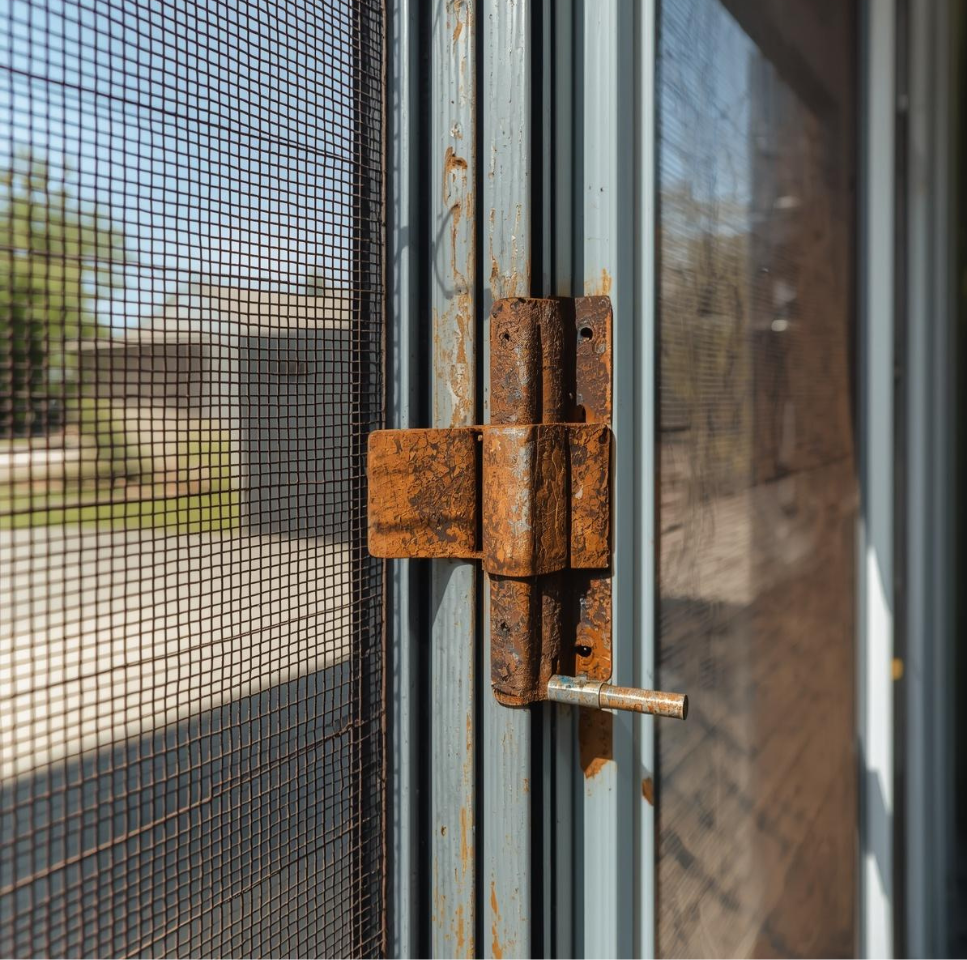
Look for white powder or rust streaks around the screws. This is galvanic corrosion eating the frame. Once the metal softens, the hinges pull loose and the door sags.
⚠️ The Bottom Track
This is the ultimate salt trap. Dirt and moisture sit in the bottom channel, pitting the metal and cracking the seals.
🎯 The Reality:A door with a 25-year mesh is useless if the lock fails in 5. A true first line of defence requires high-grade hardware, not just high-grade mesh.
Warranties: The Difference Between ‘Paper’ & ‘Protection’
A 10-year warranty usually has a massive asterisk hidden in the fine print regarding salt exposure.
🛡️ The ‘Coastal Exclusion’
Many budget brands void their warranty if you live within 5km of the ocean and don’t wash the door weekly. Look for a warranty that covers ‘corrosion and tea staining’ without the fine-print traps.
🛡️ The AS 5039 Benchmark
A door isn't security unless it passes the Knife Shear, Impact, and Jemmy tests. If they can’t show you the test results, it’s just a decorative screen.
🛡️ The Welded Advantage
This is why we recommend Prowler Proof. Because the frame is fully welded, not screwed, there are no gaps for salt to hide and no rivets to corrode. It’s the only way to get a replacement warranty that actually holds up in our air.
👉 The Bottom Line: If the salesperson can't give you a straight ‘Yes’ when you ask if the warranty covers salt corrosion, you’re looking at a 5-year door.
Maintenance: The Lifespan Doubler
In coastal environments, ‘set and forget’ is how you kill a security door. Even 316-grade steel needs help to beat the salt air. If you want to hit that 25-year mark, follow this simple routine:
💦 The 3-Month Rinse
Wash the mesh and frame with warm, soapy water (pH-neutral) every 3 months. If you’re beachfront or on a canal, make it monthly. This stops salt from bonding to the metal.
🧴 The Lock Lube
Use a silicone-based spray or graphite powder twice a year. Avoid WD-40 or heavy grease as they attract the very grit and salt you’re trying to keep out.
🧽 The Wipe-Down
Every 6 months, wipe the frame with a soft cloth. If it feels chalky, the powder coating is oxidising. A quick coat of car wax can reseal the surface and keep the aluminium underneath bone-dry.
👉 The Rule of Thumb:If your car is covered in a fine layer of salt or dust, your security door is too. Give them both a wash at the same time.
Signs It’s Time to Replace Your Aluminium Security Screen Door
A door can look fine from the street but fail when it matters. If you notice these signs, your security is likely compromised:
✅ The ‘Spongy’ Mesh: Push the mesh near the corner. If it gives or pulls away from the frame, the retention system has perished. A solid kick would put an intruder straight through.
✅ The Shadow Gap: If you see light peeking through the edges when the door is closed, the frame has sagged. This creates a perfect leverage point for a crowbar.
✅ Bleeding Screws: Orange rust or white powder ‘bleeding’ from rivets means the metal is thinning. The door is being held together by habit, not strength.
✅ The Handle Lift: If you have to lift the handle to get the deadbolt to click, the internal cams are misaligned or corroded.
✅ The Rattle: Shake the door while it’s locked. If it rattles loosely, the hardware is worn out. A secure door should feel like a solid part of the wall.
👉 The 10-Second Test:If you have to jiggle the key to get in, you'll struggle to get out in an emergency. If the lock is fighting you, the door is finished.
The Bottom Line: 5 Years vs 25 Years
An aluminium security door can last anywhere from 5 to 25 years, but the gap depends entirely on two things: material quality and how you handle the Coastal Tax.
- Standard screens often rely on thin protective coatings and basic aluminium mesh. In salt air, these can begin rusting out or pitting in as little as five years.
- Premium security screens—specifically those with 316 stainless steel mesh and welded frames—are built for durability.
- Maintaining structural integrity and appearance isn't 'set and forget'. Even the best doors need a basic rinse to clear dust and dirt from the locks and hinges.
If your door feels spongy, shows bleeding rust, or the lock is fighting you, it’s likely reached its limit. Investing in the right screen today means you won't be replacing it again in five years.
For more information on aluminium or stainless steel security screens, call our friendly Moreton Bay Security Solutions team on 0439 015 936 or complete our enquiry form today.
Resources:
Choice.com.au - What to know before buying a security screen door
Perth Homeguard - How Long Do Security Doors Last? Your New Door Timeline Explained
Amplimesh - Maintaining and Caring for Your Security Screens
Prowler Proof - What is the Best Security Screen Material for Screens and Doors?